Most materials in the library are available for you to browse freely. Please visit the shelves directly to look for books or journals (articles).
・
If you already know which book or journal you want to read:
Use
OPAC or another catalog to check its location and go to find it on the shelf.
・
If you want to see what kind of resources are available: Browse the shelves related to your topic and select any materials that seem useful.
Walking through the shelves and exploring related materials is known as browsing. Looking at the books physically can help you discover new topics or keywords.
When you find a book related to your theme in the OPAC, check the nearby shelves too. You may come across other books on closely related subjects.
Basic Arrangement (Books)
Library materials are organized based on their format (e.g., books, journals, audiovisual materials, microforms) and type (e.g., general books, reference books). Within each designated section, materials are arranged in order by call number.
Reference: Materials Arrangement in the Central Library
Books are sometimes divided into "Books in East Asian Languages" and "Books in Other Languages":
・Books in East Asian Languages (和図書 / Watosho): Books written in Japanese, Chinese or Korean
・Books in Other Languages (洋図書 / Yotosho): Books written in languages other than Japanese, Chinese or Korean
Libraries / Locations
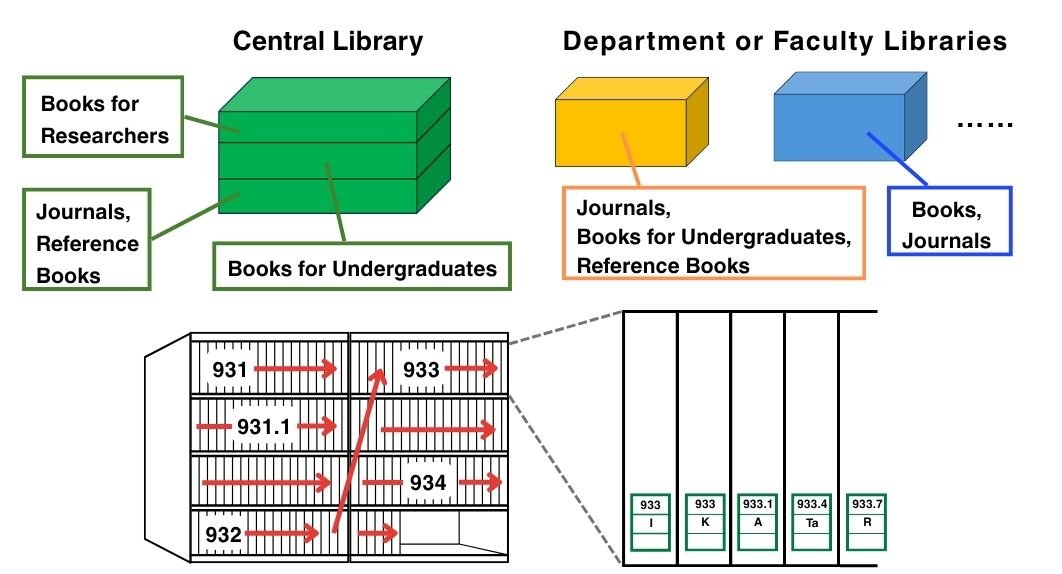
Books are housed not only in the Central Library, but also in departmental or faculty libraries. Within each library, books are organized by type and subject. Some libraries may also have separate shelves for syllabus-recommended books or materials on specific subjects.
Examples (Central Library):
・Books for Undergraduates: Books for undergraduate students, pocket paperbacks, books for international students, job-hunting resources, language learning materials, etc....
・Books for Researchers: Highly specialized academic books in area such as humanities, social science, natural science, local history, Asian studies, etc....
●Library → Location by materials type → Cell number
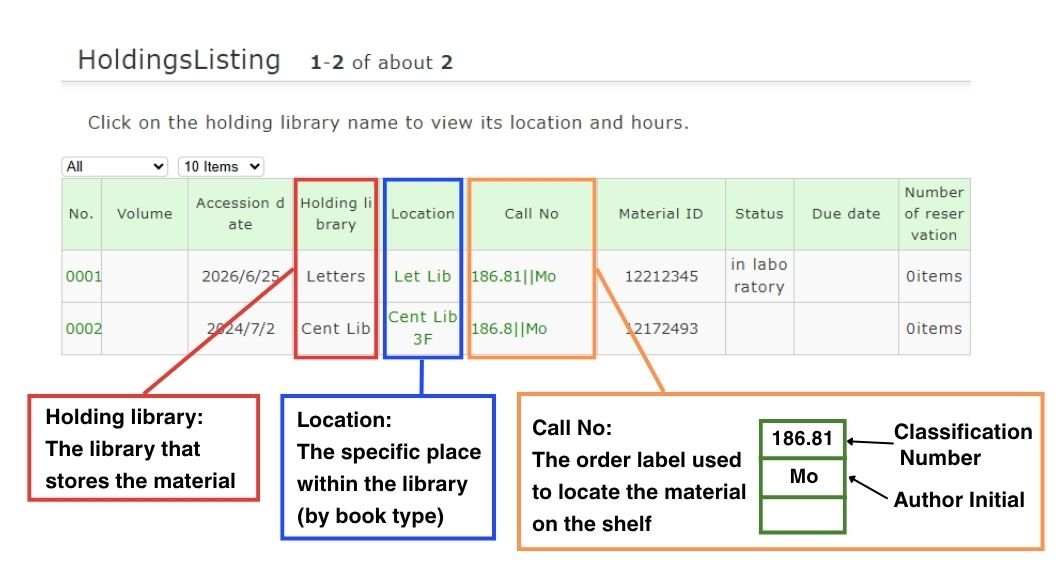
●OPAC detail
●Laboratory Collection
If the "Status" column in the OPAC shows "in laboratory," the item is located in a faculty office or laboratory. If you wish to use the item, please contact the library indicated under "Location."
Please note that some items may be unavailable or take time due to research use. If the same material is available at another library location, we recommend using those instead.
Classification Number / Shelving Oeder (Cell Number)
Examples (Central Library):
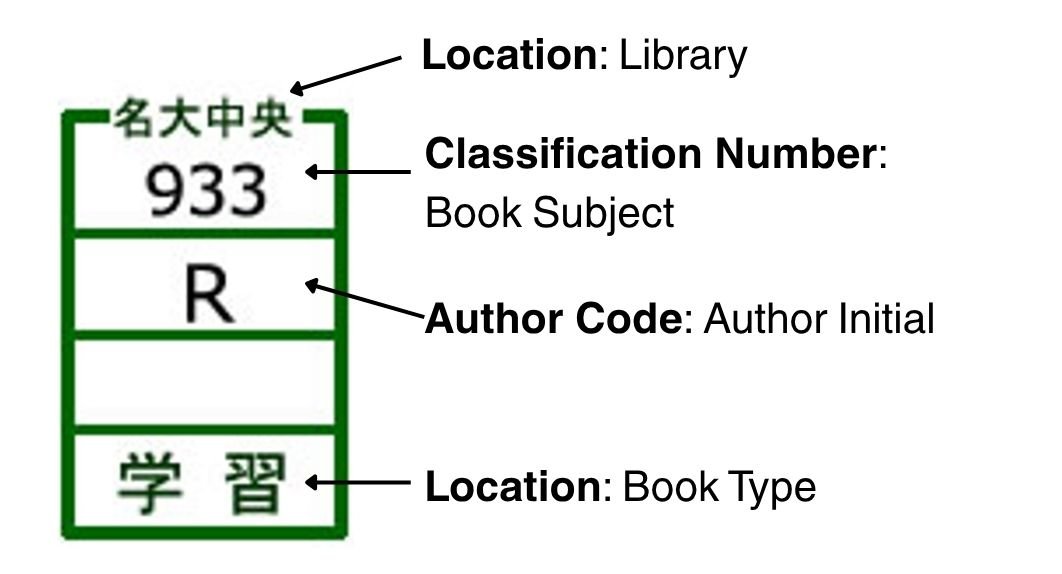
A label attached to the spine of each book displays its call number, and books are arranged according to their call number.
The first line shows the classification number on the NDC (Nippon Decimal Classification) system. This system uses numbers from 0 to 9, including decimal points, to categorize knowledge in detail. Books are assigned classification numbers based on their subject, so materials on similar topics are shelved close together.
The second line shows an author code, typically based on the author's initial in the Roman Alphabet. Books are shelved in order of the first line (classification number) followed by the second line (alphabetical author code).
●Exceptions to Classification
Depending on the library room or the type of collection (material category), some materials may be concentrated in a specific subject area (resulting in many items having the same classification number), or the subject area may be too broad (making detailed classification less practical). In such cases, shelving may follow a system other than the standard NDC.
These include:
・Using an original, non-NDC classification scheme
・Adding further subdivisions to the standard NDC classification
・Arranging books by title of the series or by author's name
Although classification systems may differ, the basic principle remains the same: materials are shelves by call number (the number of the spine label) within each location and material type.
Basic Arrangement (Journals and Newspapers)
Journals are publications issued on a regular or irregular basis (weekly, monthly, quarterly, or annually) and continued indefinitely. They are also known as serials.
Journals in East Asian Languages (和雑誌) / Journals in Other Languages (洋雑誌)
In many libraries, journals are arranged alphabetically by title rather than by classification number.
Example of arrangement:
・Journals in East Asian Languages: Number → Japanese syllabary order → Hangul → Roman alphabet
・Journals in Other Languages: Numbers → Roman alphabet → Cyrillic and Greek letters
・Newspapers: Sorted separately for East Asian Language/ Other Languages, arranged by title order
Note:Some libraries may arrange journals using classification numbers like books.
Current Issues / Bound Journals
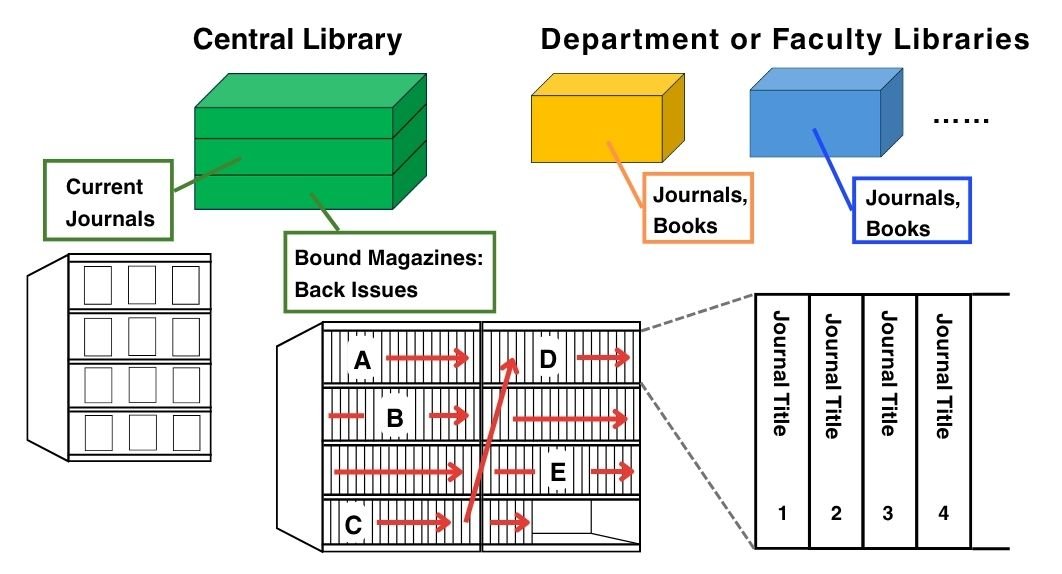
In most cases, journals are bound together after a certain period following their arrival (known as bound volume or back issues). For example, monthly journals are typically bound and preserved about one-year after their arrival.
The location of current issues and bound journals may differ. In some libraries, only the current issues are kept on site, and the bound volumes are later transferred to the Central Library for long-term storage.
●Libraries → Location (Journal) → Title Order → Volume / Issue Number
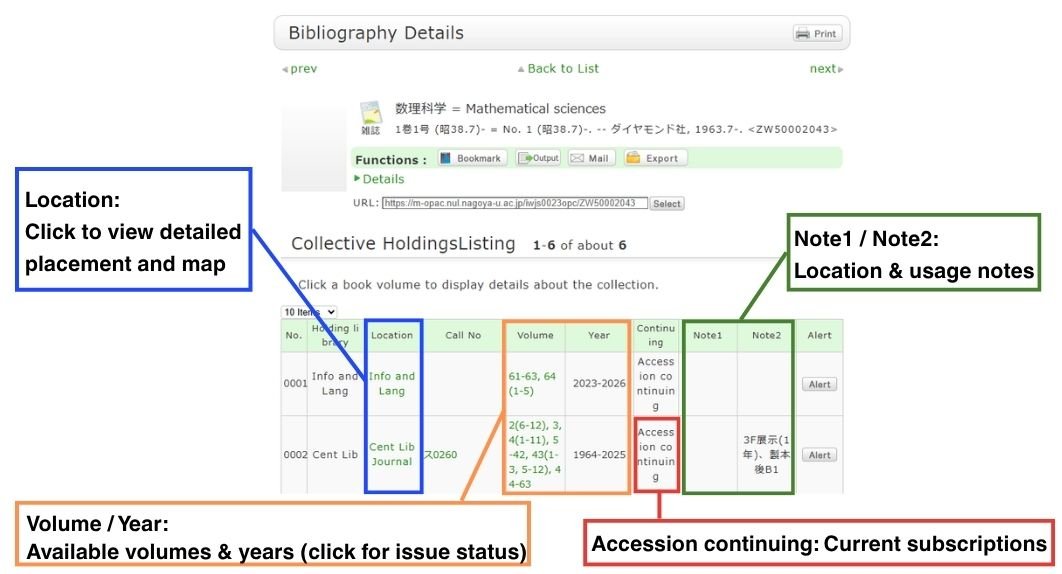
●OPAC details
●Journals which NOT Retained Long-Term
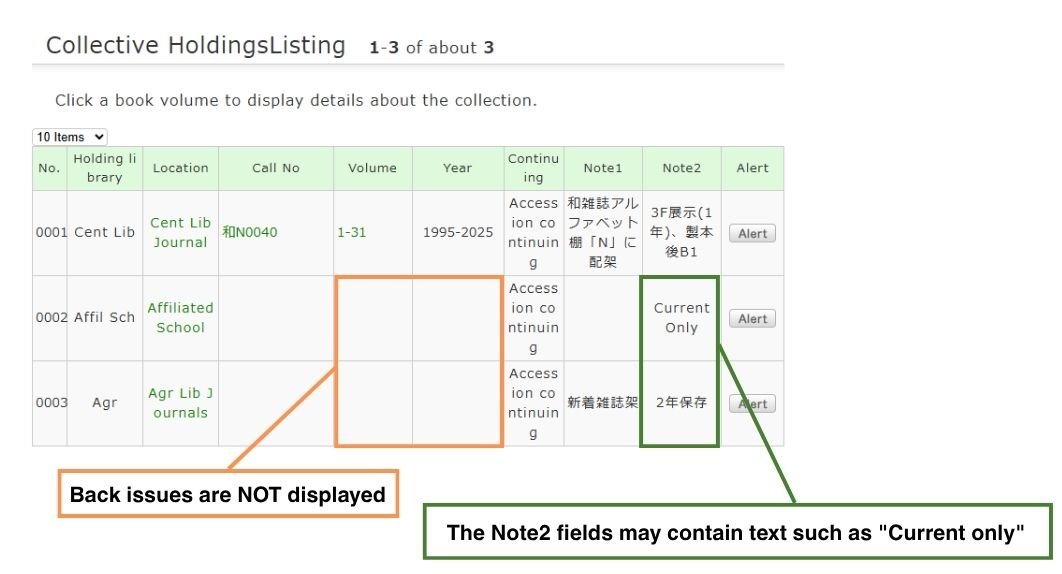
Some titles―such as general-interest magazines or donated journals―are kept only for the most recent few months to one year. Older issues are not preserved sometimes.
On the OPAC detailed view, there is indicated by a note such as "Current only" in the remarks section.
Types of Journals
University libraries hold a wide range of periodicals, including academic journals, university bulletins, and general-interest magazines.
・Academic Journals: Published by academic publishers or scholarly societies, primarily featuring research articles.
・University Bulletins: Journals issued by Nagoya University and other academic institutions, containing research papers and reports. Often published annually.
・General Magazines: News, lifestyle and hobby magazines.
・Newspaper: Domestic and international newspapers, as well as trade-specific ones. Older issues may be available in microform or CD-ROM.
For many general newspapers, only the most recent few months to a year are kept, so please be sure to check the range of available issues.
Older issues of newspaper may be stored in bound volumes, much like journals. In some cases, libraries also preserve them in microfilm or facsimile reprints.